Pilot Training Guide
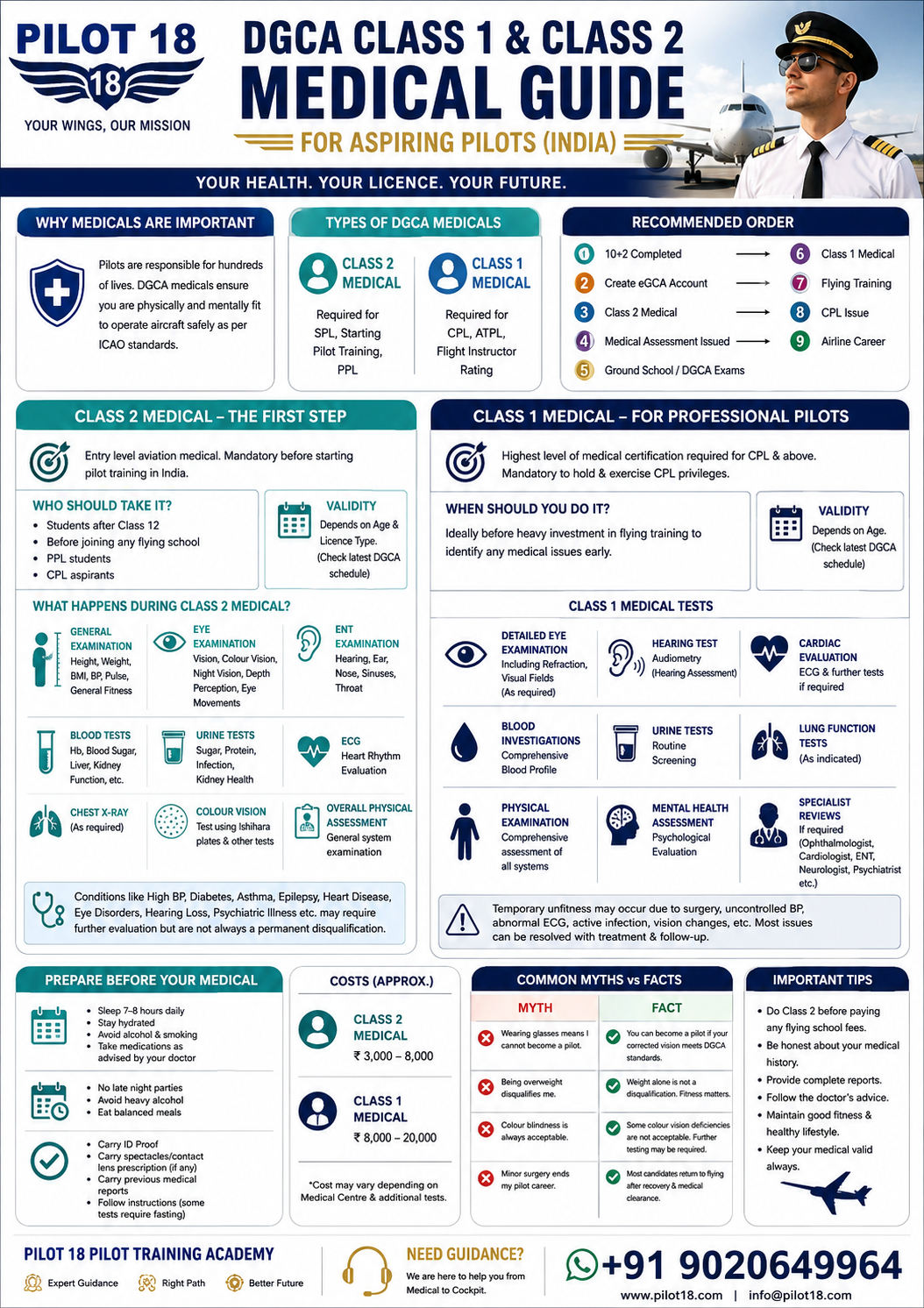
DGCA Class 1 & Class 2 Medical Guide for Aspiring Pilots (India)
Everything You Need to Know Before Starting Pilot Training
Many aspiring pilots spend ₹50–80 lakhs on pilot training without first confirming that they meet the required medical standards. The DGCA Class 2 Medical is the first step, and obtaining it before joining any ground school or flying academy can help you avoid costly surprises. Before you can hold a Commercial Pilot Licence (CPL), you must also obtain a valid DGCA Class 1 Medical Certificate.
Why Are Pilot Medicals So Important?
Pilots are responsible for the safety of hundreds of passengers. Even a minor medical condition that affects vision, hearing, balance, or mental alertness can compromise flight safety.
DGCA medical examinations ensure that every pilot is physically and mentally fit to fly according to international ICAO standards.
Types of DGCA Medicals
| Medical | Required For |
|---|---|
| Class 2 Medical | Student Pilot Licence (SPL), beginning pilot training, PPL |
| Class 1 Medical | Commercial Pilot Licence (CPL), Airline Transport Pilot Licence (ATPL), Flight Instructor Rating |
Recommended Order
10+2 Completed
        │
        ▼
Create eGCA Account
        │
        ▼
Class 2 Medical
        │
        ▼
Medical Assessment Issued
        │
        ▼
Ground School / DGCA Exams
        │
        ▼
Class 1 Medical
        │
        ▼
Flying Training
        │
        ▼
CPL Issue
        │
        ▼
Airline Career
DGCA Class 2 Medical
Purpose
Class 2 Medical is the entry-level aviation medical.
Without it, you generally cannot proceed with pilot training in India.
Who Should Take It?
- Students after Class 12
- Students before joining any flying school
- PPL students
- CPL aspirants
Pilot18 Recommendation: Complete your Class 2 Medical before paying any academy or flying school fees.
What Happens During the Class 2 Medical?
The medical examiner evaluates your overall health, including:
General Examination
- Height
- Weight
- BMI
- Blood pressure
- Pulse
- General physical fitness
Eye Examination
One of the most important sections.
Tests include:
- Distance vision
- Near vision
- Colour vision
- Night vision (if required)
- Depth perception
- Eye movement
- Eye pressure (when indicated)
- Squint examination
Can I Wear Spectacles?
Yes.
Many airline pilots wear spectacles or contact lenses, provided their vision can be corrected to the required standard.
Colour Vision
Candidates undergo colour perception testing.
If an applicant does not pass the initial screening test, further assessment may be required. Some colour vision deficiencies may be incompatible with commercial pilot certification.
ENT Examination
Doctor checks:
- Hearing
- Ear health
- Nose
- Sinuses
- Throat
Good hearing is essential for radio communication.
Blood Tests
Typically include:
- Haemoglobin
- Blood sugar
- Liver function
- Kidney function
- Blood grouping (where required)
Urine Examination
Checks:
- Sugar
- Protein
- Infection
- Kidney health
ECG
Heart rhythm evaluation.
Chest X-ray
Performed where required by the examining authority.
Medical Conditions That May Need Further Evaluation
Examples include:
- High blood pressure
- Diabetes
- Asthma
- Heart disease
- Epilepsy
- Significant psychiatric illness
- Serious neurological disorders
- Certain eye diseases
- Hearing impairment
Having one of these conditions does not automatically mean permanent disqualification, but additional investigations or specialist reports may be required before a decision is made.
Class 2 Medical Validity
The validity depends on factors such as age and the type of licence. DGCA periodically updates validity schedules, and revised guidelines have been in effect since September 2025. Always refer to the latest DGCA schedule or your medical assessment for the applicable validity period.
DGCA Class 1 Medical
Class 1 Medical is the highest level of medical certification required for professional pilots.
You cannot be issued or exercise the privileges of a Commercial Pilot Licence (CPL) without a valid Class 1 Medical.
When Should You Do Class 1?
Many students wait until after beginning flight training.
However, it is generally advisable to complete your Class 1 Medical as early as possible, ideally before investing heavily in flying hours, to identify any significant medical issues early.
Class 1 Medical Tests
In addition to the Class 2 evaluation, Class 1 is more comprehensive and may include:
Vision
- Detailed eye examination
- Colour vision
- Refraction
- Visual fields (when indicated)
Hearing
- Audiometry (hearing assessment)
Heart Examination
- ECG
- Additional cardiac investigations if clinically indicated
Blood Investigations
More comprehensive laboratory tests as required.
Urine Tests
Routine screening.
Lung Function
Performed when indicated.
Physical Examination
Comprehensive assessment of all body systems.
Mental Health Assessment
The examiner evaluates whether any psychological or psychiatric condition could affect flight safety.
Specialist Reviews
If required, referrals may be made to specialists such as:
- Ophthalmologist
- Cardiologist
- Neurologist
- ENT specialist
- Psychiatrist
- Orthopaedic specialist
Common Reasons for Temporary Unfitness
Examples include:
- Recent surgery
- Uncontrolled blood pressure
- Active infection
- Abnormal ECG requiring evaluation
- Significant vision changes
- Untreated medical conditions
Many of these issues can be resolved with treatment and follow-up.
Common Myths
❌ “Wearing glasses means I cannot become a pilot.”
False. Corrective lenses are acceptable if your corrected vision meets DGCA standards.
❌ “Being overweight automatically disqualifies me.”
False. Weight alone is not a disqualification, although obesity-related health issues (such as uncontrolled hypertension or diabetes) may require further evaluation.
❌ “Colour blindness is always acceptable.”
False. The degree and type of colour vision deficiency matter. Further testing may be required, and some deficiencies may not meet commercial pilot standards.
❌ “Minor surgery ends my pilot career.”
False. Most candidates return to flying after appropriate recovery and medical clearance.
How to Prepare Before the Medical
One week before:
- Sleep 7–8 hours daily.
- Stay hydrated.
- Avoid excessive alcohol.
- Follow prescribed medications unless advised otherwise by your doctor.
One day before:
- Avoid late-night parties.
- Do not smoke excessively.
- Eat a balanced meal.
On the day:
- Carry your identification documents.
- Bring any spectacles or contact lens prescription if applicable.
- Carry previous medical reports if you have any ongoing medical condition.
- Follow the instructions given by the medical centre (some tests may require fasting).
Approximate Costs
| Medical | Approximate Cost |
|---|---|
| Class 2 Medical | ₹3,000–8,000 |
| Class 1 Medical | ₹8,000–20,000 |
These are indicative ranges and vary depending on the approved centre, investigations required, and whether additional specialist consultations are needed.
Frequently Asked Questions
Can I become a pilot if I wear spectacles?
Yes, if your corrected vision meets DGCA standards.
Is LASIK allowed?
In many cases, yes, after successful healing and subject to DGCA medical requirements and evaluation.
Is diabetes allowed?
It depends on the type, severity, treatment, and level of control. Individual assessment is required.
Can I become a pilot after heart surgery?
Possibly. A detailed cardiology evaluation and DGCA review would be required.
Is colour blindness acceptable?
Some colour vision deficiencies may not meet commercial pilot standards. Further testing is often required if the initial screening is not passed.
Pilot18 Expert Advice
At Pilot18 Pilot Training Academy, we recommend this sequence for every aspiring pilot:
- ✅ Create your eGCA account.
- ✅ Complete your DGCA Class 2 Medical before paying any flying school fees.
- ✅ Begin DGCA ground classes and examinations.
- ✅ Complete your DGCA Class 1 Medical as early as practical.
- ✅ Start flying training only after confirming that your medical requirements are on track.
This approach can save significant time, money, and stress if any medical issue requires further evaluation.
📞 Need Guidance?
Pilot18 Pilot Training Academy provides complete support for aspiring pilots, including:
- ✅ DGCA Class 2 Medical guidance
- ✅ DGCA Class 1 Medical guidance
- ✅ eGCA registration assistance
- ✅ DGCA ground classes
- ✅ Flying school selection
- ✅ India & abroad pilot training counselling
- ✅ DGCA licence conversion guidance
📱 Call / WhatsApp +91 9020649964